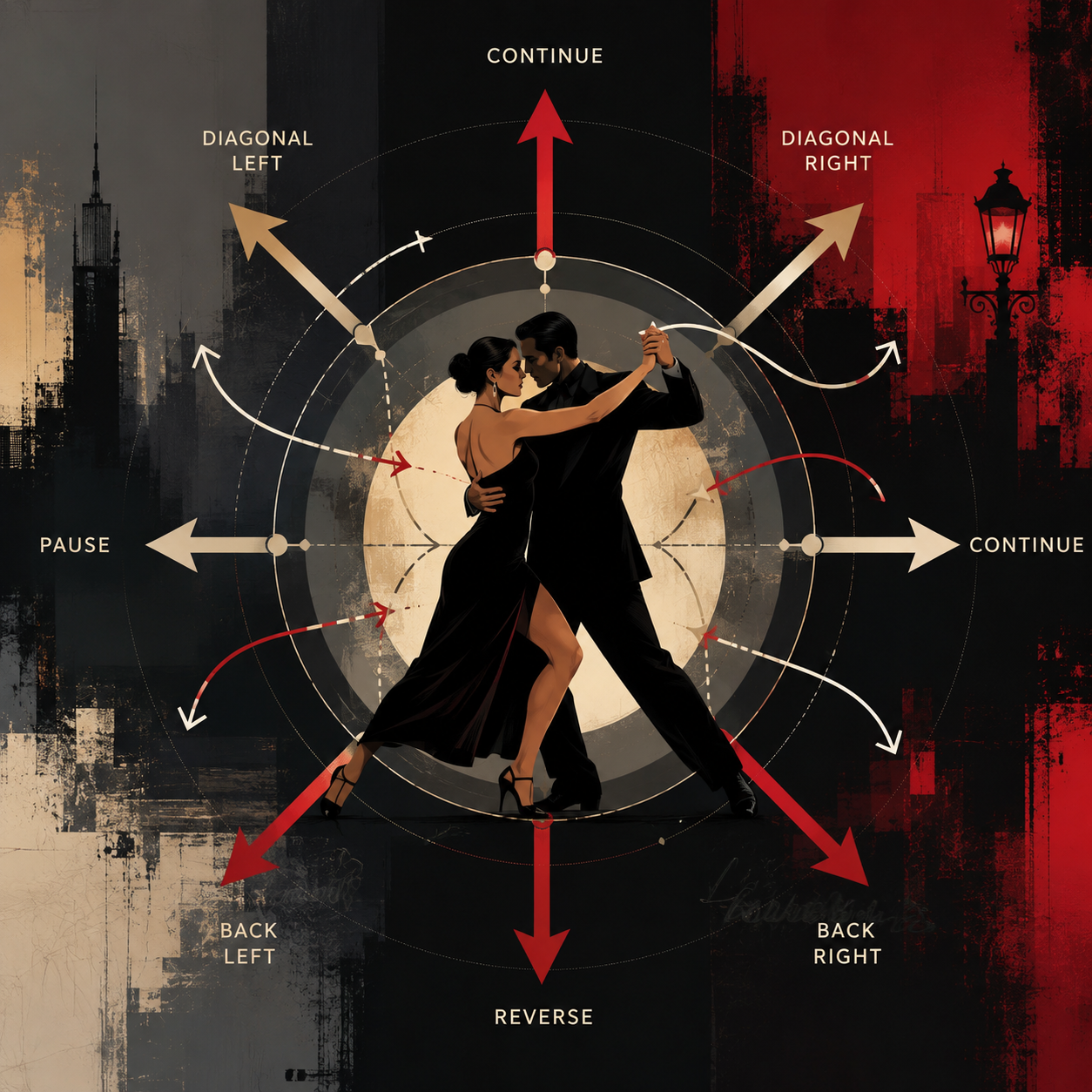
Contrary to what most tango teachers teach, I prefer to think of tango not in figures or steps, but as a series of moves, where every move can be paused (either in the middle or at the end) and then reversed or continued.
That gives every move at least six different ways to be executed (actually more, but let’s not overcomplicate things for now). And each of these ways may or may not lead to a named or familiar figure consisting of a series of moves.
Thinking and dancing like this gives you more flexibility on a crowded dance floor, more ways to mitigate misunderstandings with your partner, and more possibilities to react to the music as it develops (in other words: increased musicality).
We dance the music not the steps.
~Carlos Gavito~
In Playing While Walking: Cortados, Traspie, Rebote.., I explored this idea in the context of walking. Now I want to explain how to apply it to the ocho.
The standard ocho (there are other ways of entering into it) consists of the following moves by the leader:
- Side step
- Silent weight change
- Initiating the follower’s pivot
- Side step accompanying the follower’s back or forward step
- Initiating the follower’s pivot
- Side step accompanying the follower’s back or forward step
- Initiating the small pivot that returns the follower to the basic position
- Silent weight change
That the side step and the silent weight change can be paused and then reversed or continued is trivial, but it can still be useful depending on the available space, the music, or the follower’s reaction.
More unusual is the idea of pausing and reversing the pivot. But in fact, that’s exactly what you do when you change from a back ocho to a front ocho (or vice versa). You can actually play with this pausing and reversing on the spot several times.
The same is true for accompanying the follower’s back or forward step. You may stop and reverse at the end of the step instead of initiating another pivot, or even interrupt and reverse the movement in the middle of the step.
And even after you have turned the follower back into the basic position, you can still lead back into the ocho if you wish, and start the whole game anew.
All of this can be varied in size and speed. Works in closed and open embrace.
Of course, all of this only works if the follower is prepared to react. Don’t try it on someone who has only learned the ocho as a complete figure and automatically executes it from beginning to end without listening.
So here’s a breakdown of what this means for the follower (leaders, please stay with me—there are two important hints for you at the end).
The standard ocho consists of the following moves by the follower:
- Side step
- Pivot
- Back or forward step
- Pivot
- Back or forward step
- Pivot back into the basic position
As a „good“ follower (devilish hints for daring followers will follow below), you should be attentive and listening for the following:
- Be aware that the side step can be stopped and reversed at any stage. Follow the size, speed, and pauses of the movement exactly as they are led. Your only reference point is the leader’s chest, not the feet.
- Be aware that the pivot can be stopped and reversed at any stage. Follow the energy of the lead and execute the pivot only to the degree suggested. Don’t automatically take the back or forward step after the pivot. Instead, collect (bring your feet together) and wait.
- Also be prepared to be led into a molinete if the pivot approaches 180 degrees. In reality it should be a bit more than that, but leaders are not perfect.
- Always remember that a pivot is executed through dissociation: the upper body moves first, while the lower body catches up and „snaps“ back into place.
- Be ready to be led back into the pivot even after you have apparently been returned to the basic position.
Now, here’s what you can also do yourself (traditional leaders may not like this at all, but good modern ones will love it):
You can actively stop and even reverse any of the moves mentioned above at any stage.
You stop by offering resistance through your chest, and you reverse by giving a gentle counter-energy through your chest. If the leader doesn’t understand the signal, don’t insist. Train this with a prepared partner first to find the appropriate amount of energy.
Back to leaders:
Whatever you do, never insist if the follower doesn’t understand the stopping or reversing. It might not be you. The follower may simply not be ready for it. Even followers with many years of experience sometimes aren’t, because they were taught primarily in figures.
And one final thought:
If you meet resistance, you may have encountered an active follower who wants to stop or reverse intentionally. In that case, be a good leader and follow that signal. Really good leaders always listen to the follower’s signals—and follow them.
Sadly I am not aware of any video that shows any of the options. If you encounter any, please let me know. See Ocho Variations and Back Ocho Exit Variations for even more ocho variations.
P.S.: This description got a very good review that I would like to share:
I particularly like the central idea of your text: reframing tango from a vocabulary of figures to a grammar of reversible movements. It shifts the emphasis from memorising patterns to listening, adaptability, and co-creation. It is also quietly radical, because it challenges the notion that the leader merely „executes“ figures while the follower reproduces them. Instead, both partners remain responsive throughout the dance. That may annoy some traditionalists, but it is a perspective that many contemporary social dancers will immediately recognise from their own best tandas.
Souce: ChatGTP 😉